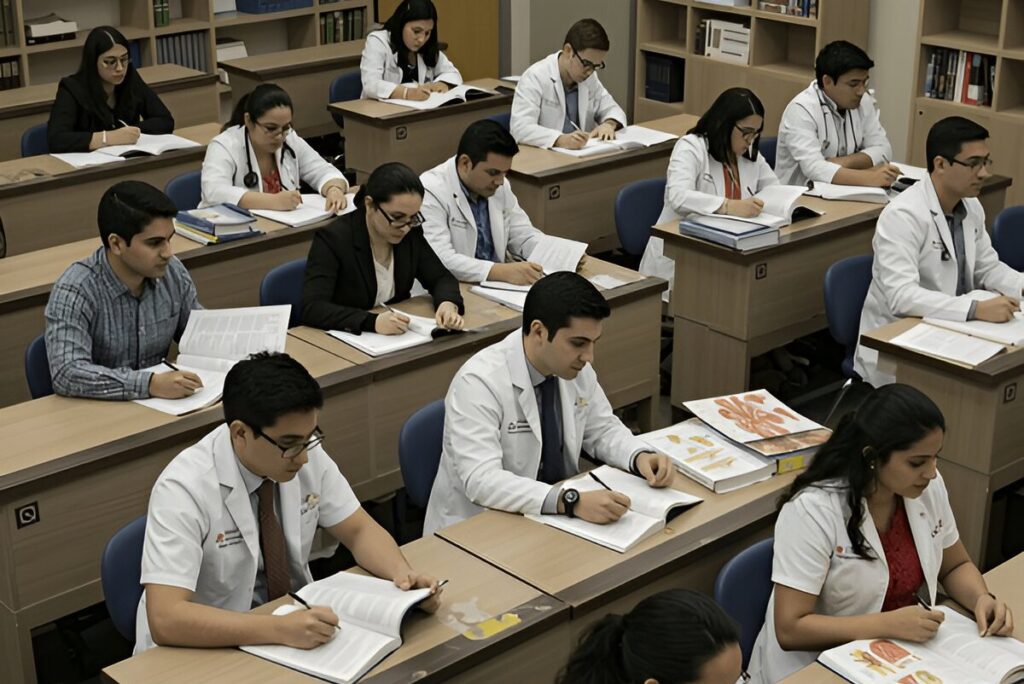

Securing a postgraduate seat in premier institutions through the AIIMS PG Entrance Exam remains a dream for thousands of medical graduates across India. Effective NEET PG admission guidance can transform this challenging journey into a structured path toward success. With intense competition and limited seats, targeted preparation becomes essential for those aiming to excel.
Understanding the AIIMS PG Entrance Exam
The AIIMS PG Entrance Exam, now conducted as INI CET, serves as the unified gateway for MD, MS, MCh (6-year), DM (6-year), and MDS programs. This exam opens doors to prestigious institutes including various AIIMS campuses, JIPMER Puducherry, PGIMER Chandigarh, NIMHANS Bengaluru, and SCTIMST Trivandrum.
Moreover, INI CET is held twice annually – typically in November for the January session and May for the July session – providing two opportunities each year for aspirants seeking NEET PG admission guidance through this highly competitive pathway. The computer-based test features 200 questions to be solved in 180 minutes, drawing entirely from the MBBS curriculum.
Exam Pattern and Marking Scheme
A clear grasp of the structure proves vital for efficient time management. The table below outlines key details:
| Aspect | Details |
|---|---|
| Mode | Computer-Based Test (CBT) |
| Duration | 180 minutes (3 hours) |
| Total Questions | 200 (Mix of single correct and multiple correct) |
| Marking Scheme | +1 for correct; -1/3 for incorrect |
| Unanswered | 0 marks |
| Language | English |
Building a Strong Foundation: Syllabus Overview
The syllabus spans pre-clinical, para-clinical, and clinical subjects from the MBBS level. High-weightage areas include Medicine, Surgery, Obstetrics & Gynecology, Pediatrics, and Orthopedics.
Subject-Wise Weightage Insights
Previous trends reveal approximate question distribution:
| Phase | Subjects | Approximate Questions |
|---|---|---|
| Pre-Clinical | Anatomy, Physiology, Biochemistry | 20-25 |
| Para-Clinical | Pathology, Microbiology, Pharmacology, Forensic Medicine, Community Medicine | 50-60 |
| Clinical | Medicine, Surgery, OBGYN, Pediatrics, Ophthalmology, ENT, etc. | 115-130 |
Effective Study Plan for Success
Preparation timelines vary, yet a 6-12 month structured approach works best for most aspirants. Consistency is prioritized over marathon sessions.
Phase-Wise Preparation Strategy
- Foundation Phase (First 4-6 Months) Concepts from standard MBBS textbooks are thoroughly covered. Notes on high-yield topics are created for future revisions.
- Intensive Phase (Next 3-4 Months) Subject-wise MCQs are practiced daily. Weak areas through error analysis are identified and strengthened.
- Revision and Mock Phase (Last 2-3 Months) Multiple revisions are completed. Full-length mocks are taken weekly, followed by detailed performance reviews.
Daily targets, such as 300-400 MCQs alongside theory, are set. Moreover, weekly revisions prevent forgetting curves from impacting retention.
Recommended Resources
Standard textbooks combined with review books form the core:
- Pre-Clinical: Gray’s Anatomy (selective), Ganong Physiology, Harper Biochemistry
- Para-Clinical: Robbins Pathology, Ananthanarayan Microbiology, KD Tripathi Pharmacology
- Clinical: Harrison Medicine, Bailey & Love Surgery, DC Dutta Obstetrics
- Review Books: PROAFS by Vivek Jain (PSM), Review of Pathology by Gobind Rai Garg, Self-Assessment series for various subjects
Image-based learning is focused on using atlases and online resources for Radiology and Dermatology.
Mastering Revision Techniques
Revision is emphasized as the game-changer. Multiple cycles are planned – at least 4-5 full revisions before the exam.
- Short notes and flashcards for quick recalls are maintained.
- A dedicated “mistake notebook” for repeated errors is kept.
- Group discussions for doubt clearance are joined when possible.
In the final month, grand tests are simulated under exam conditions. Time management is practiced to attempt all questions comfortably.
Common Mistakes to Avoid
Many aspirants falter despite hard work. These pitfalls are sidestepped:
- Concepts are neglected in favor of rote learning.
- Mocks are skipped or not analyzed properly.
- Clinical integration and image-based questions are ignored.
- Health and sleep are compromised during preparation.
- Over-confidence leads to inadequate revision of strong subjects.
Balanced routines with exercise and breaks are maintained for sustained performance.
Previous Year Cutoff Trends (For Reference)
Cutoffs vary by category and branch, but top branches at AIIMS Delhi close within top 100-200 ranks (General category). For instance:
| Branch | AIIMS Delhi Approx Closing Rank (Recent Sessions) |
|---|---|
| Radiodiagnosis | 20-50 |
| Medicine | 50-120 |
| Orthopedics | 100-200 |
| Pathology/Micro | 1000+ |
Exam Day Strategies
Calmness is preserved on the big day. The paper is scanned first to identify easy questions.
- High-yield short subjects are attempted early for confidence building.
- Tricky or lengthy questions are flagged and returned to later.
- Guessing is minimized due to negative marking.
Admit card, ID proof, and a light breakfast are ensured beforehand.
Conclusion
Cracking the AIIMS PG Entrance Exam demands disciplined effort, smart strategies, and unwavering focus. With the right NEET PG admission guidance embedded in daily routines, conceptual mastery is achieved, and top ranks become attainable. Preparation is started early, mistakes are learned from, and consistency is embraced – success will follow. Begin the journey today and move closer to that coveted PG seat.
Frequently Asked Questions (FAQs)
When should serious NEET PG admission guidance begin for cracking the AIIMS PG Entrance Exam?
Toppers suggest starting structured NEET PG admission guidance immediately after internship, allowing 10–12 months for full syllabus completion, multiple revisions, mock tests, and pattern-based preparation. This duration provides balanced learning, stronger conceptual clarity, and better exam temperament for the AIIMS PG Entrance Exam.
How many study hours are suggested daily under proper NEET PG admission guidance?
Ideal preparation involves 8–10 focused hours daily, using active recall, MCQ practice, and spaced revision. Effective NEET PG admission guidance emphasizes consistency, strategic break intervals, and understanding-based study to match the demanding pattern of the AIIMS PG Entrance Exam for better performance.
Which subjects dominate the question paper in the AIIMS PG Entrance Exam?
Clinical subjects such as Medicine, Surgery, Obstetrics and Gynaecology, and Paediatrics contribute nearly two-thirds of the AIIMS PG Entrance Exam. Strong NEET PG admission guidance prioritizes repeated revision of these subjects to maximize scoring potential and ensure balanced preparation across high-yield areas.
Why is image-based question practice critical for the AIIMS PG Entrance Exam?
Approximately one-fourth of the AIIMS PG Entrance Exam consists of image-based questions. Therefore, NEET PG admission guidance recommends daily practice of diverse visuals, including radiology, pathology, and clinical images, to strengthen recognition skills and prevent avoidable mistakes during the examination.
How to tackle negative marking smartly with expert NEET PG admission guidance?
Intelligent attempt selection is essential. Students are advised to answer only when reasonably confident, while marking uncertain questions for review. Structured NEET PG admission guidance teaches controlled guessing strategies, focusing on accuracy to achieve a competitive score in the AIIMS PG Entrance Exam.
Is self-study sufficient to get a top-100 rank in the AIIMS PG Entrance Exam?
Self-study can indeed secure a top rank when executed with discipline, mock analysis, and strong conceptual focus. Many rankers follow NEET PG admission guidance principles independently, using standard textbooks, online assessments, and consistent revisions to excel in the AIIMS PG Entrance Exam.
How do short subjects help boost overall score in the AIIMS PG Entrance Exam?
Short subjects such as Radiology, Dermatology, Psychiatry, and Anaesthesia collectively provide highly scoring opportunities. NEET PG admission guidance highlights revising these subjects thoroughly during the final phase for a strong score boost in the AIIMS PG Entrance Exam with optimal effort.
What is the ideal frequency of mock tests during NEET PG admission guidance phase?
A full-length mock every few days is recommended initially, increasing frequency closer to the exam. NEET PG admission guidance also stresses detailed analysis of each test, enabling continuous improvement and helping students adapt effectively to the AIIMS PG Entrance Exam environment.
Are previous-year questions still relevant for the current AIIMS PG Entrance Exam pattern?
Previous-year questions remain extremely relevant because exam concepts recur in revised forms. Thoroughly reviewing them helps identify core topics. Hence, NEET PG admission guidance consistently includes structured PYQ analysis as a key component for effective AIIMS PG Entrance Exam preparation strategies.
When should the final high-yield revision start under NEET PG admission guidance?
High-yield revision ideally begins 45–60 days before the exam. This phase focuses on concise notes, frequently missed topics, and rapid-review material. NEET PG admission guidance emphasizes targeted consolidation to significantly enhance scoring performance in the AIIMS PG Entrance Exam.